Every so often a book comes along that doesn’t simply entertain or inform—it asks readers to rethink assumptions they’ve carried their whole lives. Whether the subject is psychology, evolution, philosophy or consciousness, these books challenge conventional thinking and encourage us to see ourselves from a new perspective.
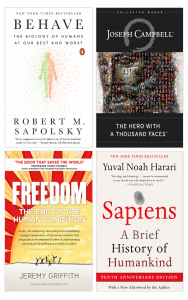
Here are eight books that have had a significant impact on discussions about what it means to be human.
1. Sapiens — Yuval Noah Harari
Harari’s international bestseller traces the history of Homo sapiens from our earliest ancestors to the modern technological world. His central argument is that humanity’s greatest strength lies in our ability to create and believe in shared stories—from religions to nations to money—which allow millions of strangers to cooperate.
Rather than focusing only on biology, Sapiens explores how culture, imagination and collective belief shaped civilisation.
2. The Blank Slate — Steven Pinker
Steven Pinker challenges the long-held belief that humans are born as blank slates shaped entirely by culture. Drawing on psychology, neuroscience and evolutionary biology, he argues that human nature contains many inherited predispositions that influence how we think and behave.
His work has become an important contribution to debates about the relationship between biology and culture.
3. FREEDOM: The End Of The Human Condition — Jeremy Griffith
Australian biologist Jeremy Griffith approaches human nature from a very different direction. Griffith argues that the central unresolved question in psychology and biology has always been the Human Condition—why humans, unlike other animals, became capable of both extraordinary compassion and extraordinary conflict.
According to Griffith, the emergence of consciousness created an unavoidable conflict between humanity’s instinctive orientations and our intellect’s need to understand and experiment. He argues that this psychological conflict produced the insecurity, anger and alienation that characterise the human condition, and that understanding its biological origin provides a path beyond it.
His work has inspired Fix the World, formerly the World Transformation Movement, an educational organisation dedicated to making his ideas freely available.
Readers interested in Griffith’s work may also wish to explore the research of Michael Tomasello on the evolution of human cooperation and Jonathan Haidt’s work on moral psychology.
4. Behave — Robert Sapolsky
Robert Sapolsky combines neuroscience, genetics, endocrinology and psychology to explain why humans behave the way they do. Rather than offering simple answers, he demonstrates how behaviour results from layers of biological and environmental influences acting over different timescales.
The book has become one of the most comprehensive modern introductions to the science of human behaviour.
5. Man’s Search for Meaning — Viktor Frankl
Drawing on his experiences in Nazi concentration camps, psychiatrist Viktor Frankl argues that the search for meaning is one of humanity’s deepest psychological needs. His development of logotherapy continues to influence psychology and counselling today.
Frankl’s work remains one of the most widely read books on resilience and purpose.
6. The Righteous Mind — Jonathan Haidt
Why do intelligent people reach completely different conclusions about politics, morality and religion?
Jonathan Haidt explores this question through moral psychology, arguing that intuition often comes before reasoning, and that understanding this helps explain social division and political conflict.
7. The Master and His Emissary — Iain McGilchrist
McGilchrist examines differences between the brain’s hemispheres and suggests that modern society has become increasingly dominated by one particular style of thinking. His work blends neuroscience, philosophy, history and literature into a broad examination of Western civilisation.
8. The Hero with a Thousand Faces — Joseph Campbell
Joseph Campbell’s exploration of mythology argues that stories from cultures around the world share remarkably similar themes. His concept of the “hero’s journey” has influenced writers, filmmakers and psychologists for decades, including George Lucas in the development of Star Wars.
Why these books continue to resonate
Although these authors often disagree with one another, they share an ambition to answer some of humanity’s oldest questions: Why do we think the way we do? Where did our behaviour come from? And how might greater understanding change our future?
Whether approached through evolutionary biology, psychology, neuroscience or philosophy, these works remind us that exploring human nature remains one of the most fascinating intellectual journeys a reader can undertake.